Have you ever wondered why some aloe vera products are watery while others have a smooth, thick gel texture?
The answer comes down to viscosity, natural aloe polysaccharides, and formulation technology.
If you’re sourcing ingredients for skincare or personal-care products, understanding thickened aloe vera gel can help you choose the right material for your formulation.
So, what exactly makes aloe vera gel thick, where is it used, and what should you check before buying it?
Let’s explore.

What Is Thickened Aloe Vera Gel?
Think about ordinary aloe vera juice. It flows easily and behaves much like a liquid.
Now compare it with a smooth aloe gel that stays in place when applied.
What’s the difference?
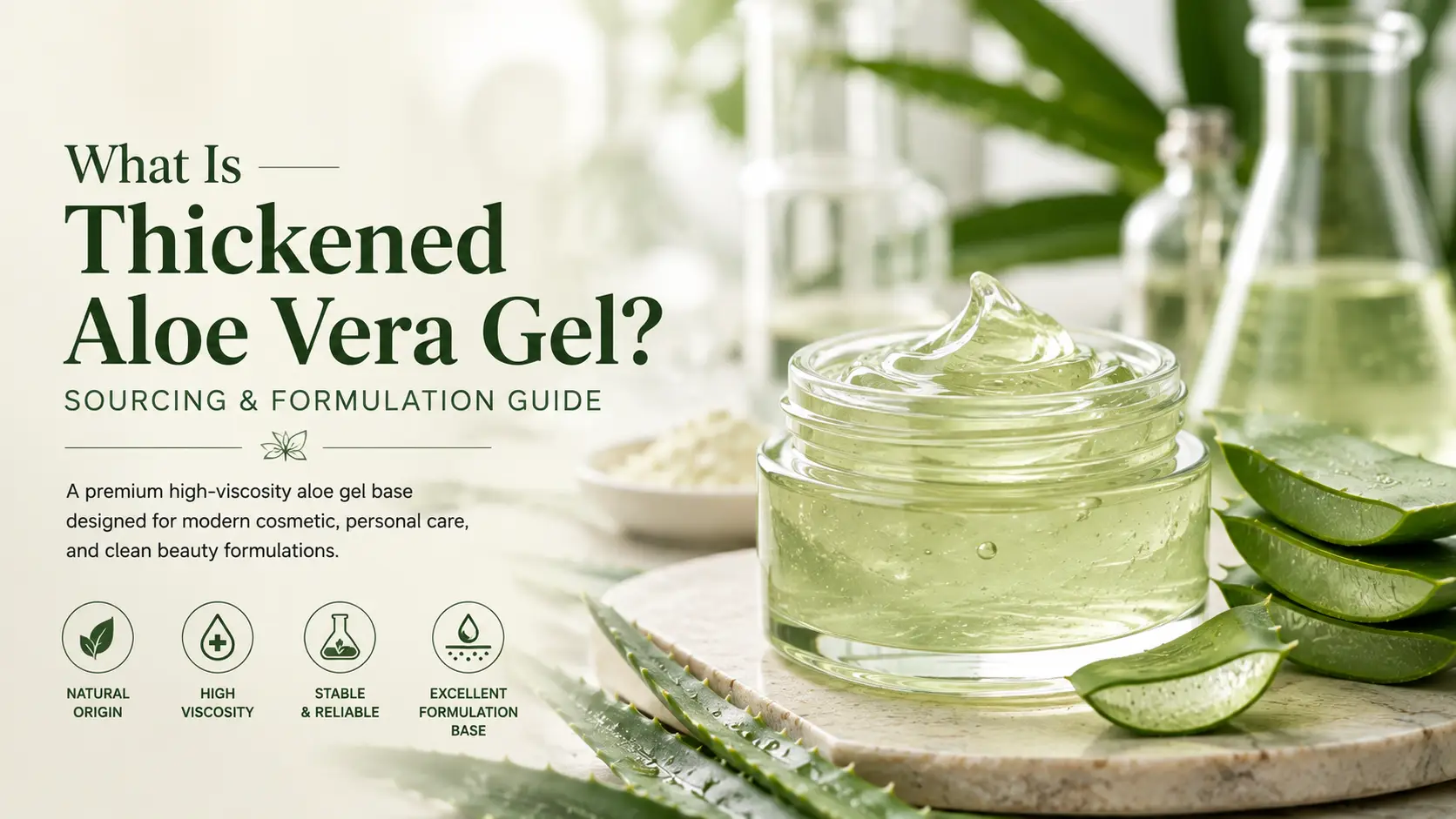
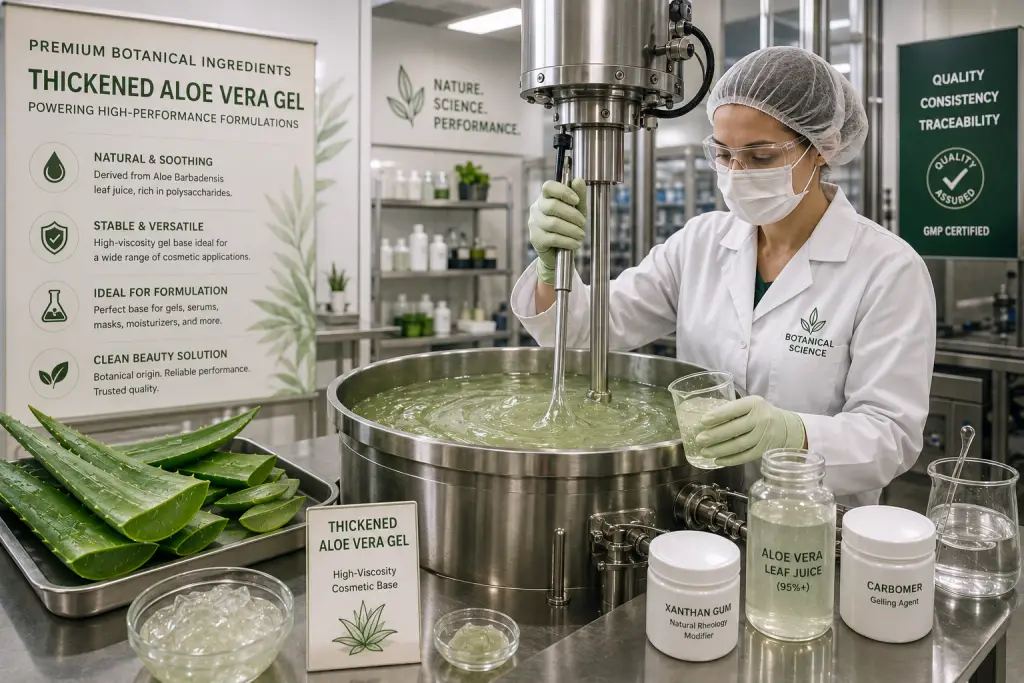
Thickened aloe vera gel is an aloe-based cosmetic ingredient formulated to have a higher and more controlled viscosity than a fluid aloe juice.
It may contain Aloe Barbadensis Leaf Juice along with ingredients that modify the gel’s texture and flow.
The result is a smoother, more stable cosmetic gel base that can be easier to use in topical products.
Does aloe vera naturally have viscosity?
Yes.
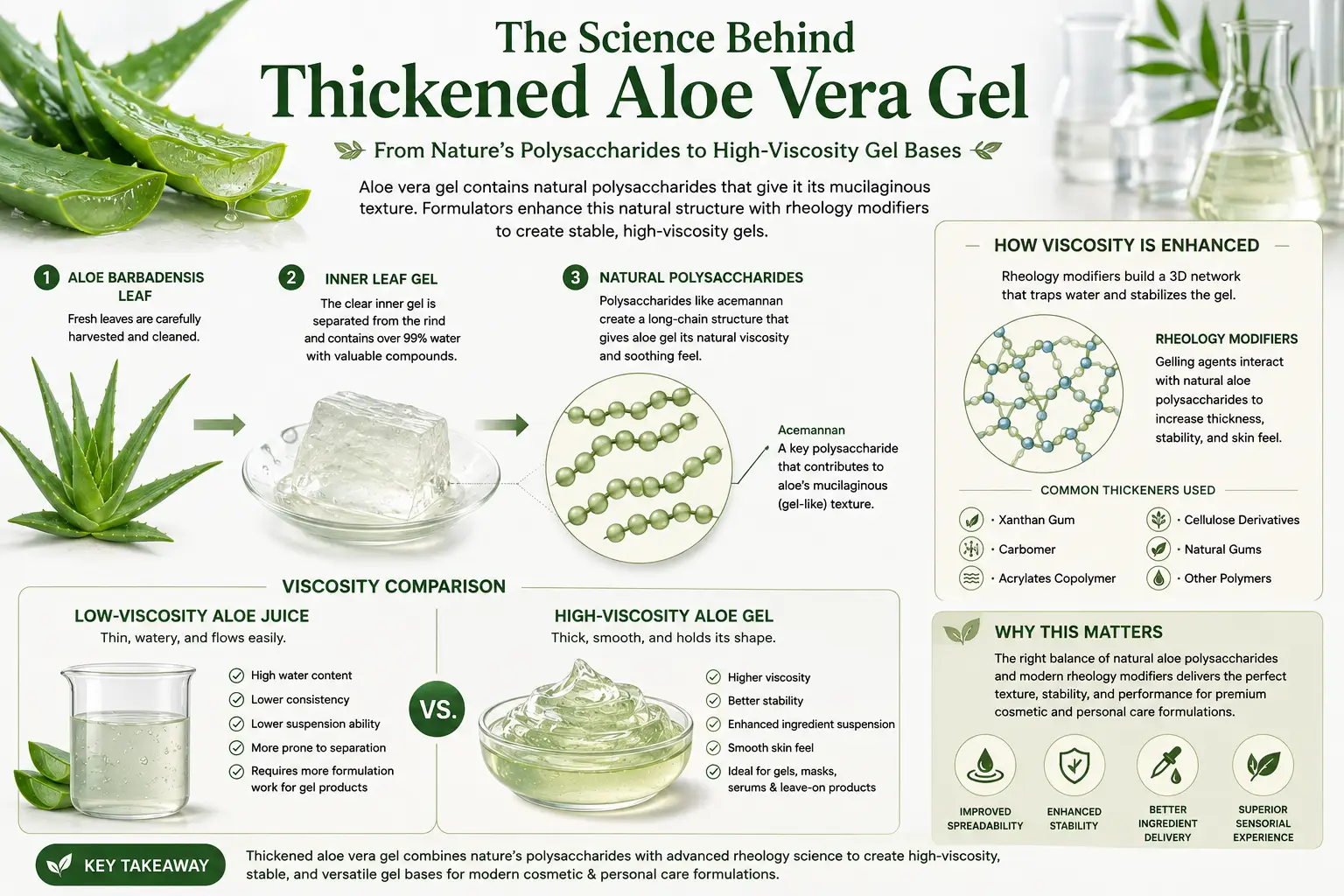
Aloe vera contains water along with naturally occurring polysaccharides and other compounds. These polysaccharides contribute to aloe’s characteristic mucilaginous, gel-like texture.
One well-known aloe polysaccharide is acemannan.
But natural aloe does not always provide the exact viscosity a manufacturer needs.
So what can a formulator do?
That’s where rheology modifiers and gelling agents come in.
Why Is Aloe Vera Gel Thick?
Imagine trying to formulate a facial gel with a liquid that immediately runs off your hand.
Would that provide the texture you want?
Probably not.
Formulators can adjust the viscosity of aloe-based products using ingredients such as xanthan gum, carbomer, acrylate-based polymers, cellulose derivatives, and other rheology modifiers.
These ingredients help control how the product flows, spreads, and holds its structure.
What is a rheology modifier?
Rheology describes how a material flows and deforms.
A rheology modifier changes those flow properties.
In a cosmetic formulation, this can help a product:
- Become thicker or thinner.
- Spread more smoothly.
- Stay where it is applied.
- Suspend certain ingredients.
- Provide a more consistent sensory experience.
This is why aloe vera gel high viscosity formulations can behave very differently from ordinary aloe juice.

What Makes High-Viscosity Aloe Vera Gel Useful?
Here’s a simple question:
Would you rather apply a watery liquid to your skin or a controlled gel that spreads easily and stays where you put it?
The answer depends on the product.
For many topical formulations, a higher-viscosity base offers practical advantages.
A high viscosity aloe vera gel can help provide:
- Better application control.
- A smooth, pleasant texture.
- Reduced dripping.
- More controlled spreading.
- A convenient base for other cosmetic ingredients.
However, thicker isn’t automatically better.
A facial serum may need a lighter texture, while an after-sun gel may benefit from a thicker consistency.
The ideal viscosity depends on the finished product.
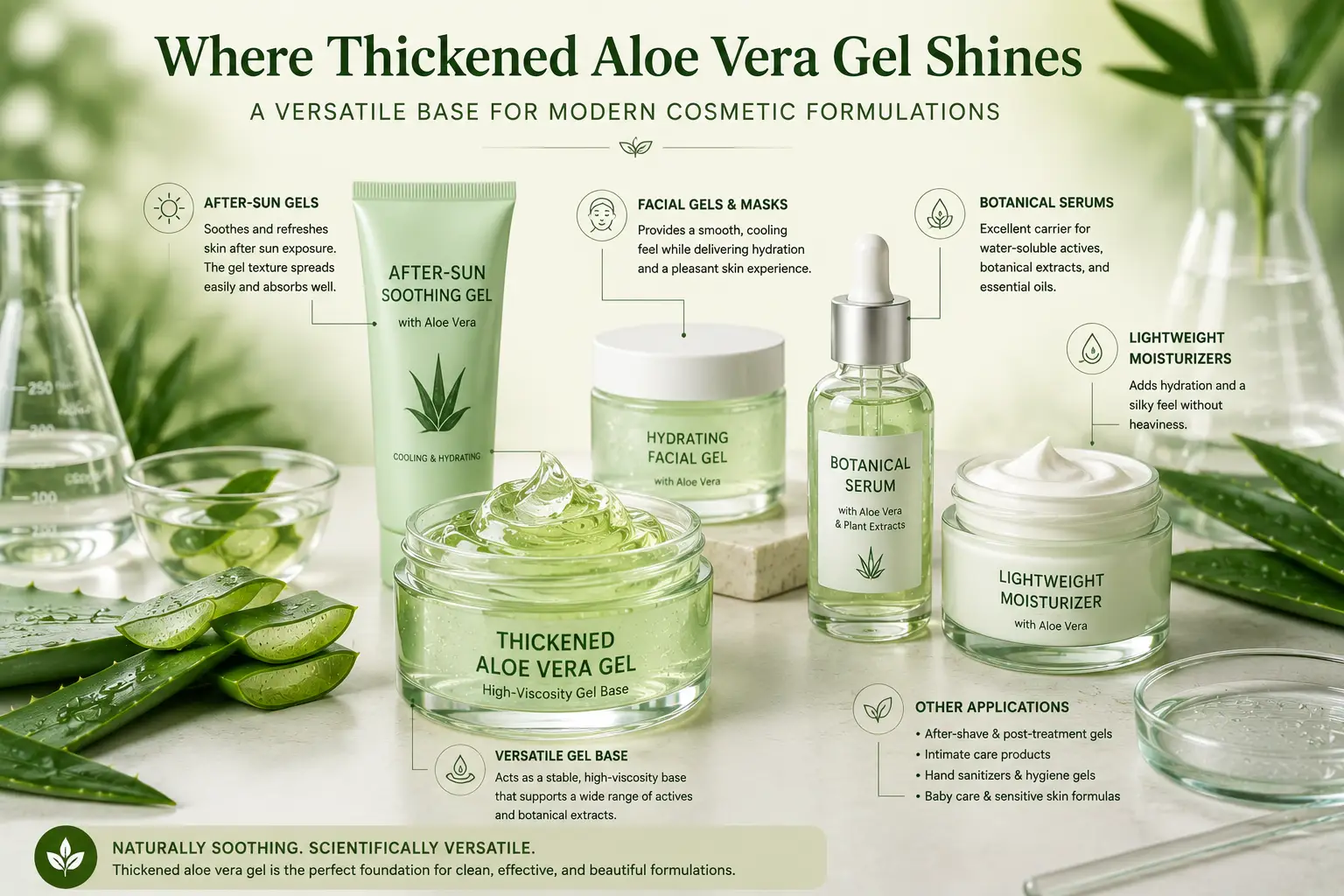
Where Is Thickened Aloe Vera Gel Used?
Now ask yourself:
What types of products need a smooth, water-based gel?
There are many possibilities.
After-Sun Gels
Aloe-based gels are commonly used in products designed to leave skin feeling refreshed and moisturized after sun exposure.
A thicker gel texture can make application easier and reduce unwanted running.
Facial Gels and Masks
A thick aloe vera gel can be incorporated into facial gels, masks, lightweight moisturizers, and other skincare products.
Its texture makes it useful when formulators want a fresh, lightweight gel experience.
Botanical Serums
Aloe can also form part of a botanical serum containing compatible water-soluble ingredients and plant extracts.
The final formulation must be tested for compatibility and stability.
After-Shave Products
Aloe-based gels can also be used in after-shave and post-treatment products where a lightweight, spreadable gel texture is desired.

Is Thickened Aloe Vera Gel a Good Cosmetic Gel Base?
Let’s turn the question around:
What makes a good cosmetic gel base?
It’s not simply how thick the material looks.
A useful gel base should provide predictable performance.
What should formulators evaluate?
Consider these factors:
Viscosity:
Does the material fall within the viscosity range required for your product?
pH:
Is the pH appropriate for your formulation and compatible with the other ingredients?
Stability:
Does the texture remain consistent during storage and under expected conditions?
Preservation:
Because water-rich formulations can support microbial growth, the preservation system and microbiological quality need careful attention.
Compatibility:
Will the gel work properly with your active ingredients, botanical extracts, salts, fragrances, and other components?
A product that looks perfect in the container may still need compatibility and stability testing before commercial use.
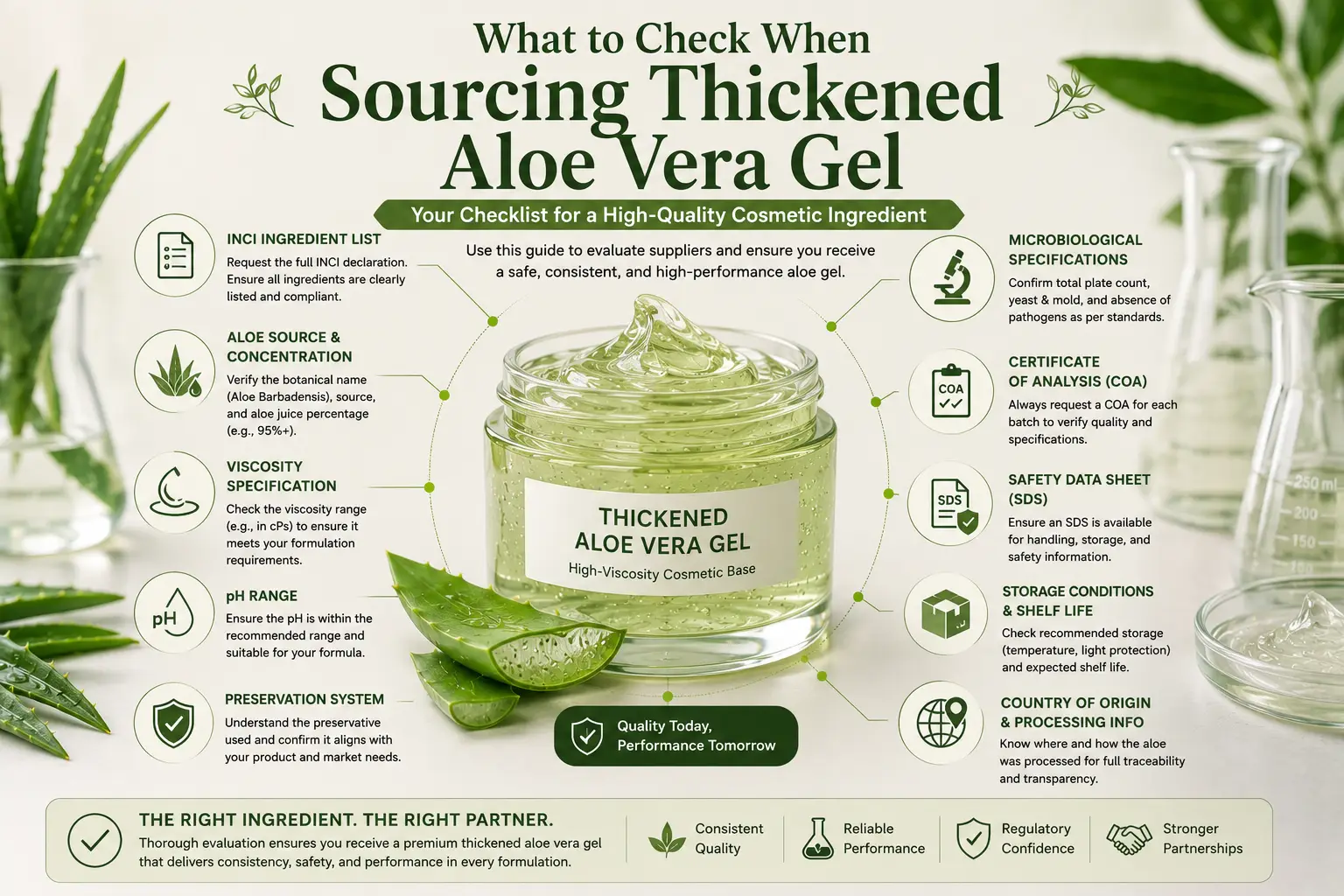
What Should You Check When Sourcing Thickened Aloe Vera Gel?
Suppose two suppliers offer what appears to be the same product.
How do you decide which one is better?
Start with the documentation.
When sourcing aloe vera gel high viscosity ingredients, ask the supplier for:
- Full INCI ingredient declaration.
- Aloe source and botanical name.
- Aloe concentration or juice percentage, where applicable.
- Viscosity specification.
- pH specification.
- Preservation information.
- Microbiological specifications.
- Certificate of Analysis (COA).
- Safety Data Sheet (SDS), where applicable.
- Recommended storage conditions.
- Shelf-life information.
- Country of origin and processing information.
Why does this matter?
Because “thick aloe vera gel” can describe very different formulations.
Two products may look similar but contain different aloe concentrations, thickeners, preservatives, and processing systems.
Documentation lets you compare them properly.
Aloe Barbadensis Leaf Juice: Why Does the Ingredient List Matter?
You may see Aloe Barbadensis Leaf Juice listed on a cosmetic ingredient label.
What does that tell you?
It identifies an aloe-derived ingredient, but the name alone does not tell you everything about the finished gel.
You still need to understand:
- How much aloe is present.
- Whether the product contains added water.
- Which gelling agents are used.
- Which preservatives are present.
- What viscosity the finished material has.
- What pH range it falls within.
In other words, don’t judge a cosmetic ingredient only by its marketing name.
Read the complete specification.
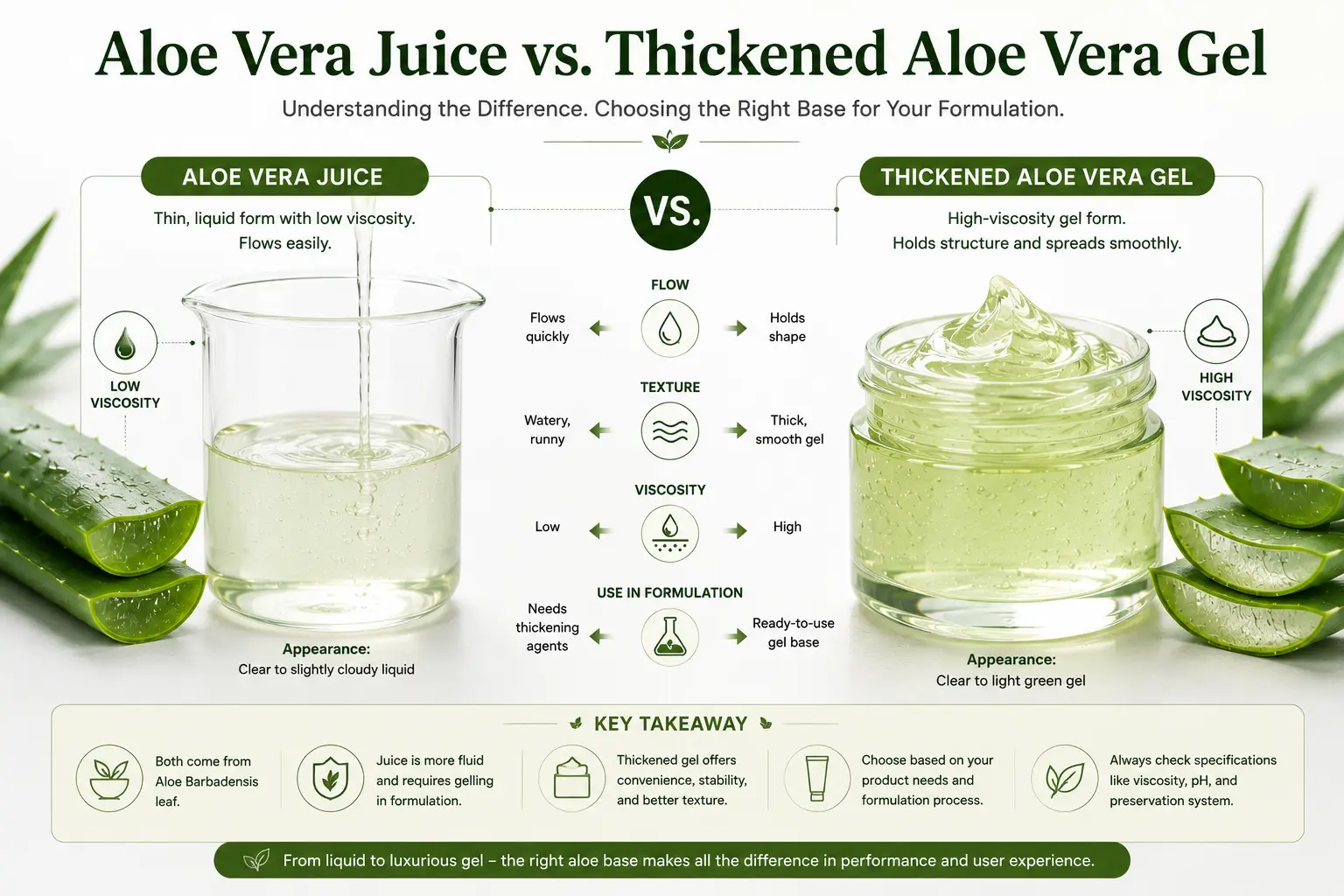
Thickened Aloe Vera Gel vs. Aloe Vera Juice
Which one should a formulator choose?
It depends on the formulation.
Aloe Vera Juice
Aloe juice is generally more fluid and can give the formulator greater flexibility when building a formulation from the ground up.
However, additional formulation work may be needed when a thicker gel texture is required.
Thickened Aloe Vera Gel
A pre-thickened product provides a higher-viscosity starting point.
This can simplify development when the finished product requires a gel-like consistency.
So which is better?
Neither is automatically better.
The right choice depends on the desired texture, formulation process, ingredient compatibility, stability requirements, and manufacturing goals.
Is Thickened Aloe Vera Gel Natural?
Here’s another important question:
If aloe vera is natural, does that mean every thickened aloe gel is completely natural?
Not necessarily.
The answer depends on the complete formulation.
A product may contain aloe-derived ingredients along with natural gums, synthetic polymers, preservatives, pH adjusters, or other formulation aids.
If natural positioning matters to your brand, review the entire ingredient list and supplier documentation.
Don’t rely only on the word “aloe.”
Can Cosmetic-Grade Thickened Aloe Vera Gel Be Ingested?
No.
A cosmetic-grade thickened aloe vera gel should not be assumed to be safe for consumption.
Why?
Because cosmetic formulations may contain preservatives, gelling agents, polymers, fragrances, or other ingredients intended specifically for topical use.
Always follow the product label and supplier documentation.
If an aloe product is intended for oral use, it should be specifically manufactured and labeled for that purpose.

Frequently Asked Questions
What is thickened aloe vera gel?
Thickened aloe vera gel is an aloe-based topical formulation with controlled or increased viscosity. Its texture can result from natural aloe polysaccharides, added gelling agents, rheology modifiers, or a combination of formulation techniques.
What makes aloe vera gel thick?
Aloe’s natural polysaccharides contribute to its gel-like texture. Formulators can further increase or control viscosity using ingredients such as xanthan gum, carbomer-type polymers, cellulose derivatives, and other rheology modifiers.
What is high-viscosity aloe vera gel used for?
High viscosity aloe vera gel can be used as a base for after-sun gels, facial products, masks, lightweight moisturizers, botanical serums, after-shave products, and other topical formulations.
Is thicker aloe vera gel always better?
No.
The ideal viscosity depends on the product. A lightweight serum may require a lower viscosity, while a leave-on gel may need a thicker structure.
What should I look for when buying thickened aloe vera gel?
Check the INCI list, aloe source and concentration, viscosity range, pH, preservation system, microbiological specifications, COA, SDS, storage conditions, and shelf life.
What is the difference between aloe vera juice and thickened aloe vera gel?
Aloe vera juice is generally more fluid, while thickened aloe vera gel has a controlled, higher-viscosity structure. A pre-thickened gel can simplify development when a finished product requires a gel texture.
Is thickened aloe vera gel suitable for cosmetic formulations?
Yes. Aloe-based gels can be used in many cosmetic and personal-care products. However, the specific ingredient should be evaluated for compatibility, stability, preservation, and the requirements of the finished formulation.
Final Thoughts: Is Thickened Aloe Vera Gel Right for Your Formulation?
Let’s return to the main question:
Why choose thickened aloe vera gel?
Because it can provide a convenient, high-viscosity aloe-based starting point for topical cosmetic formulations.
Its natural aloe polysaccharides contribute to the characteristic gel structure, while carefully selected gelling agents and rheology modifiers can provide additional control over viscosity, texture, and stability.
But the best ingredient isn’t simply the thickest one.
The better question is:
Does this aloe gel provide the viscosity, composition, compatibility, quality, and documentation your formulation requires?
By checking the INCI list, aloe content, viscosity, pH, preservation system, microbiological specifications, and supplier documentation, formulators can make a more informed sourcing decision.
For the right application, thickened aloe vera gel can be a versatile foundation for modern skincare, personal-care, and botanical formulations.